 By Ezrah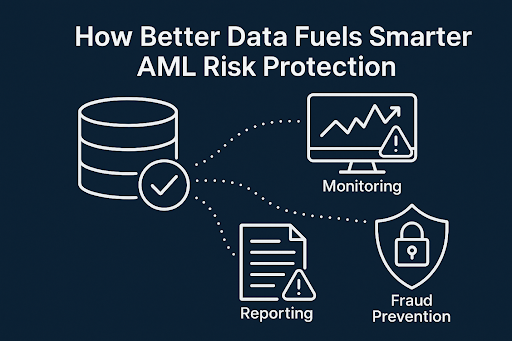
Money laundering continues to damage financial systems worldwide. The United Nations estimates that up to 2 trillion dollars is laundered each year. Financial institutions are expected to prevent crime while improving customer experience and handling more digital activity than ever before. The strength of those protections relies on one thing above all: the quality of the data fueling compliance systems.
Bad data leads to blind spots. It slows investigations, triggers false positives, hides fraud attempts, and exposes institutions to heavy penalties. Good data enables trust, speed, and accurate decision making. Flagright provides a helpful breakdown on why data quality is the foundation of effective AML compliance and how clean data boosts monitoring and reporting performance.
A clean, trusted data environment gives compliance analysts clarity and confidence when making decisions that protect customers.
Why Data Quality Has Become a Top Priority in AML Programs
Financial crime prevention has shifted from periodic checks to continuous, real time intelligence. This transformation depends on fast access to reliable data. Missing or incorrect details can create major operational challenges:
- Duplicate customer profiles obscure illicit identities
- Wrong addresses weaken KYC and sanction screening
- Poorly formatted transactions disrupt monitoring tools
- Delayed risk data results in late suspicious activity reports
Global regulators expect precision. In 2023, banks and fintechs paid more than 5 billion dollars in AML penalties according to Fenergo. In many cases, record keeping failures and low quality risk data were cited as root causes.
Institutions that invest in strong data quality build trust with regulators and reduce costly inefficiencies.
The Most Common Data Problems Holding AML Programs Back
No compliance system is perfect, but common data failings cause the most disruption:
Incomplete records
Missing fields force investigators to chase basic information.
Inconsistency across systems
Different formatting standards break API integration and scoring logic.
Outdated attributes
Risk scores lose context if customer behavior changes but profiles do not.
Limited connectivity
Disconnected datasets fail to show the true picture of suspicious activity.
Manual entry errors
Human data input introduces duplication and mismatches.
Each of these issues chips away at an institution’s ability to detect crime quickly.
How Data Quality Strengthens Every Stage of AML
High quality data serves as the operational backbone of every compliance step.
Customer Identification and Screening
- Accurate document capture
- Consistent naming conventions
- Verified identity attributes
This reduces false positives and avoids wrongfully declining customers.
Transaction Monitoring
- Clean merchant descriptions
- Reliable timestamps
- Accurate sender and receiver information
Better input drives better alerts.
Case Management and Investigations
Complete historical records limit unnecessary delays and repeat work.
Regulatory Filing Accuracy
Structured data makes SAR submissions faster, clearer, and easier to defend.
Good data reduces risk and supports compliance functions at scale.
AI Supports Better Data at the Source
Artificial intelligence relies on structure. When data is inconsistent, model quality drops. That drives many institutions to modernize.
AI enhances data quality by:
- Merging duplicate customer profiles
- Validating information during onboarding
- Detecting anomalies and formatting errors
- Filling attribute gaps with verified signals
- Identifying hidden links between accounts or users
Data cleanup no longer has to be a manual process that drains team capacity.
Breaking Down Silos Unlocks Risk Insights
Fraud and AML teams often track separate threats even though criminals blend tactics. Integrating data creates much stronger event detection.
Examples of shared intelligence that improves AML outcomes:
- High velocity card fraud signals mule behavior
- IP mismatches warn of account takeover
- Device risk scores reveal identity manipulation
- Chargeback spikes expose synthetic identity networks
Data collaboration stops more financial crime before losses escalate.
Data Quality Helps Customers Too
Compliance success should not come at the cost of user experience. Better data accelerates:
- Account approvals
- Identity verification
- Dispute resolution
- Personalized financial services
Accurate insights allow teams to block criminals while keeping legitimate users moving without friction.
Trust grows when risk controls do not slow real customers down.
Governance Ensures Better Data Over Time
Sustainable AML success requires long term planning. A strong data governance strategy includes:
Standards
Rules for how fields should be formatted and updated.
Quality measures
Scorecards that monitor improvements and gaps.
Clear ownership
Defined stewards responsible for critical data elements.
Lifecycle policies
Retention rules aligned with AML regulatory frameworks.
Governance aligns compliance, technology, and business priorities.
When Poor Data Quality Leads to Serious Compliance Trouble
Every enforcement story includes a lesson:
- SAR failures tied to missing records
- Incomplete profiles allowing sanctioned entities to transact
- Bad beneficiary data delaying investigations
- Conflicting systems leading to inaccurate reporting
These failures are preventable when data is accurate and complete.
Avoiding regulatory action costs far less than repairing compliance breakdowns later.
How Institutions Can Improve Data Quality Now
Actionable improvements do not have to be large scale migrations. Start with these priorities:
Audit key fields
Check accuracy for customer identity attributes that impact KYC.
Standardize formats
Normalize naming, addresses, and country codes.
Automate validation
Prevent errors at data entry rather than fixing them later.
Adopt tools that unify AML controls
Central platforms help teams align data and screening logic.
Many institutions accelerate these improvements by adopting AI-driven AML compliance solutions that unify screening, monitoring, and case intelligence in a single real time platform.
Better tools enforce better data rules from the start.
Strong Data Quality Builds a Safer Financial System
Criminal organizations thrive in the shadows created by incomplete information. Clean, centralized, and connected data removes those shadows. It strengthens every compliance control. It speeds up investigations. It protects customers and brands.
Financial institutions that invest in data quality position themselves for long term success. They maintain trust. They avoid costly operational risks. They build systems that adapt faster than threats grow.
Data is the foundation for stopping financial crime. The stronger that foundation is, the stronger the entire system becomes.